The fire alarm design or system at your company’s location must be operational and suitable for its intended use. The Regulatory Reform (Fire Safety) Order of 2005 mandates that practically all buildings, locations, and structures aside from private residences have a fire alarm system installed. If you are the owner of the business location, it is your duty to make sure that your space satisfies the necessary fire safety regulations. You have to make sure your system is according to the standard fire alarm design category. You may contribute to the safety of everyone in your building by following the Fire Safety Order.
What are the Fire Alarm System Categories?
According to the BS 5839 code, there are eight distinct types of fire. According to a governmental code of practice, this is the British regulation for installing fire alarms.
Each category is classified under one of three system types: property protection, life protection, or manual. The fire alarm system is installed according to;
- The type of your business
- Your kind of property
- The degree of danger associated with your work
| Standard name | Fire Alarm Category |
| Category M | Manual fire alarm system |
| Category P1 | Maximum property protection automated fire alarm system |
| Category P2 | Minimum property protection automated fire alarm system |
| Category L1 | Maximum life protection automated fire alarm system |
| Category L2 | Additional life protection automated fire alarm system |
| Category L3 | Standard life protection automated fire alarm |
| Category L4 | Modest life protection automated fire alarm system |
| Category L5 | Localised life protection automated fire alarm system |
Detailed Classifications of Fire Alarm Systems
Fire alarm design mainly classifies as;
- Manual system Category M
- Automated Fire alarm system design to save property P and P2 fire alarm
- Automated Fire Alarm design to save lives L1 to L5 fire alarm system
Manual fire alarm system or Category M
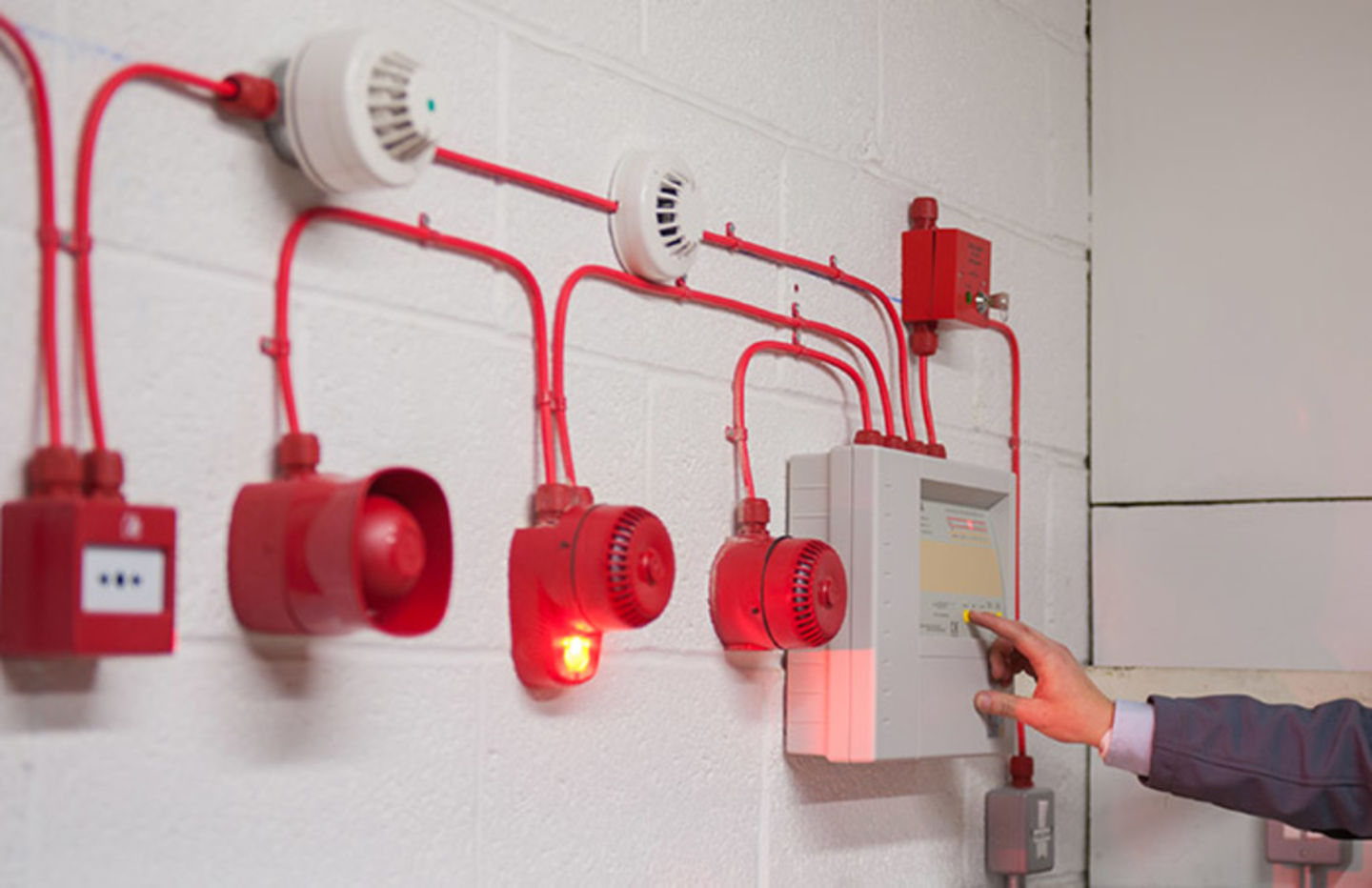
Category M is the simplest fire alarm design. When a fire is discovered, workers must manually set off alarms to warn the other occupants of the building of the danger. (However, some manual systems still use gongs or handbells if the building is relatively small and only one sounder is needed to properly sound the alarm throughout the building.) In category M, breakable glass units are used throughout the building to trigger the alarm system.
Category P1: Automated fire alarm system for maximum property protection
Category P1 systems provide the highest level of fire protection for property. In the business world, this typically entails implementing additional safety precautions in areas that are crucial to operations.
P1 systems are designed to swiftly identify fires and put them out before they have a chance to do serious harm. Occupiers can save lives and protect vital company assets by identifying them early enough. For example, a utility company may set up a P1 system in a computer room where all of its customer information is kept. P1 systems are essentially a type of business continuity planning. By using these technologies, you can minimise disturbance and save on cleanup expenses.
Category P2: Automated fire alarm system design for minimum property protection
Smoke and fire detectors are placed throughout the building by P1 systems. However, they are only placed in high-risk regions in P2 fire alarm design. P2 systems are cost-cutting strategies that use money more effectively. However, if fires break out in unexpected places, they may fail businesses.

Category L1: Automated fire alarm system with maximum life protection
The most complete automated fire alarm systems, known as L1 maximum life protection systems, have several detectors in every area of the building where a fire could start, including larger cabinets, roof spaces and voids.
In order to preserve lives, the objective is to provide residents the earliest notice possible. All parts of a structure must be covered by the system, with a few modest exclusions, such as lobbies and tiny cabinets.
Category L2: Automated fire alarm system for additional life safety
The L2 fire alarm system provides advance notice to people inside the building incase of fire in other parts of the building. This works by opening escaping routes that go to fire exits and installing smoke and fire alarms in high-risk parts of the building including kitchens.
Category L3: Automated fire alarm system for standard life protection
The L3 fire alarm design is also known as a basic life protection system. In this category, fire alarms are installed in such a way that they are positioned along every escape path that leads from the inside of the building to the fire exits. It ensures that every person inside the building has enough time to leave before smoke, fire and hazardous gases start to obstruct their escape. L3 systems are exempt from placing alarms near high-risk sources of ignition, unlike L2 fire system.
Category L4: Minimal life protection automated fire alarm system
L4 systems do not install detectors in individual rooms; instead, they merely position them along escape routes such stairways and corridors and the accompanying circulation spaces.
L4 fire alarm system users often work in low-risk settings where everyone can leave the building promptly in the case of a fire. For example, because employees can leave the building as soon as they want, ground level offices may just have L4 alarms at their entryways. However, these methods are not appropriate for multi-story businesses because employees may need more time to escape through stairways.
Category L5: Automated fire alarm system for localised life protection
One particular kind of automated fire system that addresses fire threats in high-risk regions is the L5 category alarm. For example an extra fire detector may be installed at the welding area. L5 alerts are conceptually distinct from the other fire alarm design categories. Several companies install L4 fire alarms while adding L5 fire alarm systems in high risk areas of catching fire.
Ending Note
There are several types of fire alarm design and each of them have unique features. These categories ensure the basic life and property protection. It is necessary to install a fire alarm system by a qualified specialist, such as NJR Electric and Fire, to make sure your property has the right system. NJR offers fire alarm system installation services in Brentwood, Colchester and other parts of Essex. Feel free to reach us out at 01344921501.